Vorwerk Chicken
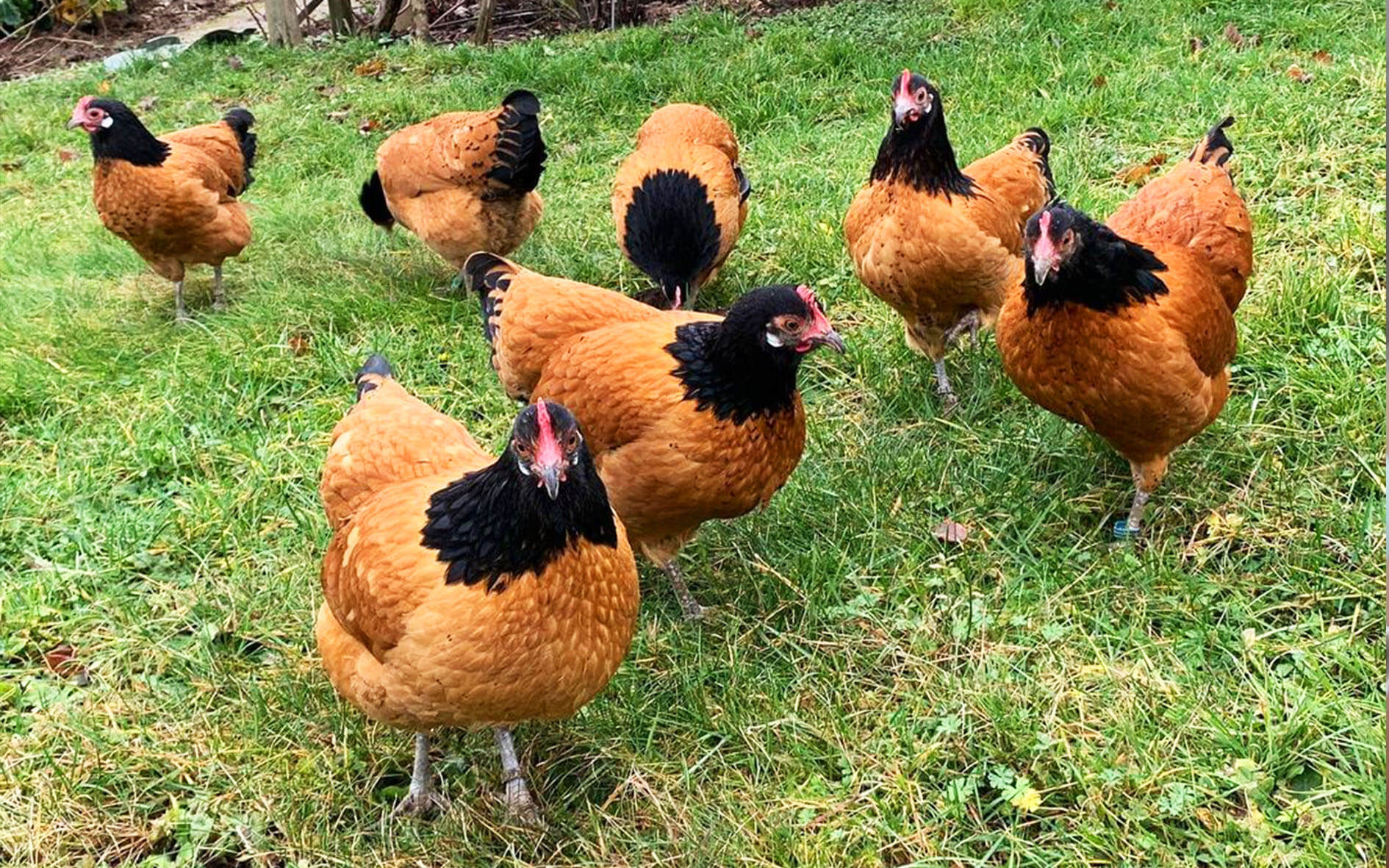
Vorwerk chickens are a German breed with a beautiful black-on-gold pattern. Next to the large fowl, there is also a Bantam version with a European strain and a separate US variety.
Let’s have a closer look.
- Characteristics
- Egg Laying
- Personality
- History
- Varieties
- Vorwerk Bantam
- US Vorwerk Bantam (by Wilmar Vorwerk)
- Summary
| Eggs | 170 eggs yearly |
| Egg Color | Cream |
| Egg Size | Medium |
| Weight | 5 – 7 lbs |
| Hardiness | Cold |
| Temperament | Active |
| Beginner-friendly | Yes |
| Color | Black-on-gold |
Characteristics
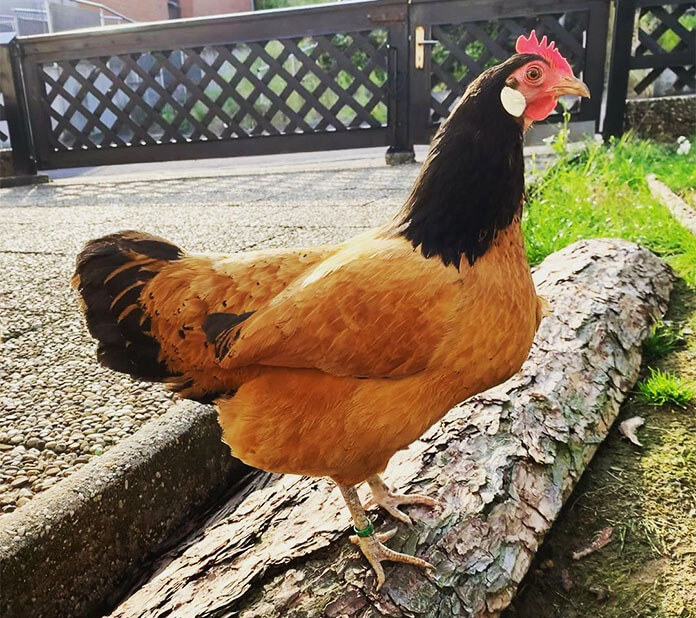
A Vorwerk chicken looks like a Lakenvelder, but the ground color of the bird is brown instead of white. The characteristic look is often confused with a Golden Lakenvelder, which is a different breed.
The roosters weigh 6 to 7 pounds (~3kg), while the hens tip the scale at roughly 5 pounds (2-2,5kg). There is also a smaller Bantam version. Essentially, two main Bantam Vorwerk strains, the American and the European, were developed independently.
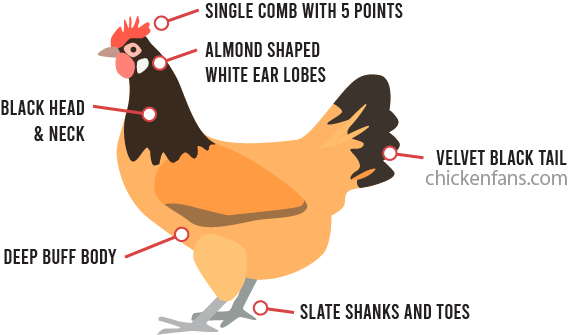
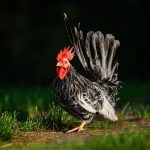
Vorwerk chickens are fast-growing, strong, medium-sized birds. They have a single bright red comb firmly straight and upright, evenly serrated with five distinct points. The earlobes are medium-sized, almond-shaped, flat, and smooth. The hackles are abundant, with the feathers falling gracefully over the shoulders and back. The tail is carried well back and spread at a 350-degree angle above the horizontal. The tail feather sickles and wing coverts are abundant and broad.
Their legs are slate, have a blueish tint, and are free from feathers. The birds have black necks, heads, and tails, while their body is brown/gold and buff-colored. The ideal Vorwerk chicken would have no signs of black pigment in its golden areas.
The black and red pigments in the plumage are the same for roosters and hens, so they look similar. It’s not an autosexing breed, either.
Egg Laying
The standard Vorwerk fowl are pretty good layers and produce around 170 eggs yearly. The eggs are off-white or cream-colored.
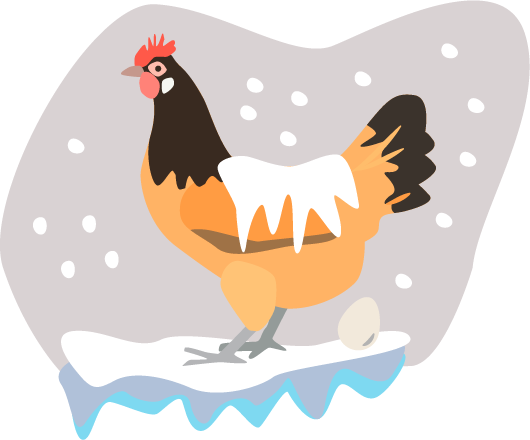
Inheriting from the Orpingtons, they lay eggs through the winter. As such, they are an ideal addition to a regular flock to get a steady stream of eggs throughout the year.
The German birds rarely get broody, but it can happen every once in a while. You most probably will need an incubator to hatch the eggs.
Personality
Vorwerk chickens are generally gentle chickens. They are active and alert like Mediterranean breeds, which doesn’t make them lap chickens.
They are fine to keep in a chicken run, and although they are proficient flyers, that doesn’t necessarily mean they will try to fly over the fence. However, they are also happy to free range.
The German birds are used to bad weather and are cold-hardy. However, if you live in a very cold climate, their single comb can be prone to frostbite.
The roosters are easily tamed, pretty tolerant towards each other, and, although active, generally not aggressive.
History
Oskar Vorwerk originally created the Vorwerk chickens in 1900. He wanted to create a variety of the Lakenvelder with a couple of changes:
- replacing white feathers so that they wouldn’t look dirty all the time
- making a dual-purpose breed that could be used for eggs as well as meat
Vorwerk created the chickens using selective breeding based on the Lakenvelder, Buff Orpington, Buff Sussex, and Andalusian chickens.
After completing his mission, the new strain got his name and was first presented in poultry shows in 1912.
Due to the prominent role of Germany in World War II, the Vorwerk breed was almost completely wiped out of existence.
Origins of the Vorwerk Bantam
In Europe, independent breeders started to create their own Bantam versions of the Vorwerk. As such, there are probably multiple lines in existence at this moment.
In 1966, Wilmar Vorwerk, a chicken breeder from New Ulm in Minnesota, became interested in the European Vorwerk Bantams, as the breed was carrying his name. He was unable to get any eggs, so he decided to create his own bantam version from scratch. We’ll discuss his selective breeding method in depth later in the article.
Varieties
The Vorwerk breed is primarily defined by European and British Poultry Standards. The strain is not listed in the Standard of Perfection of the American Poultry Association or the Australian Poultry Standard.
There is also a Vorwerk Bantam variety. The Vorwerk Bantam is listed as a single variation in the recognized breeds of the American Bantam Association.
Vorwerk Bantam
The Vorwerk Bantam is the miniature version of the large fowl. There are European strains of the Vorwerk Bantam, and Wilmar Vorwerk created an American variant. As always with Bantams, they produce smaller and fewer eggs than large fowl.
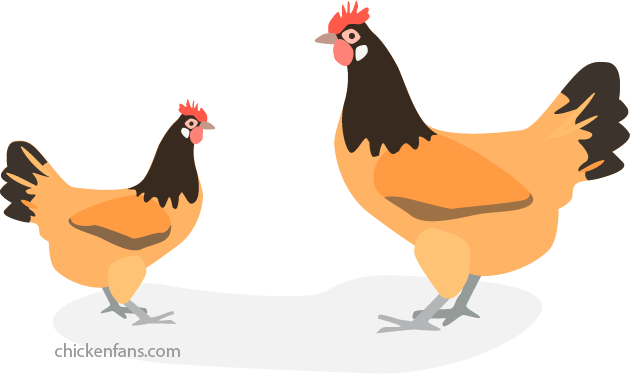
In Europe, the Bantam Vorwerk is slightly heavier than its American counterparts. European roosters are ~900 grams (32oz), and hens ~700 grams (24oz). The European roosters are about 5 ounces heavier than their US counterparts which only get to 27 ounces. Hens are roughly the same, although the US versions are, on average, an ounce lighter.
The Vorwerk Bantams are enthusiastic, active, and alert chickens. The chicks are quick to find their water and feed. When old enough to go outside, they scratch the soil all day long. They will find every little spot in the run and are the last to get back in the coop at night. They are very docile but proficient flyers and can strike the air like pheasants. However, that doesn’t necessarily mean they will fly over the fence.
The US Vorwerk Bantam By Wilmar Vorwerk
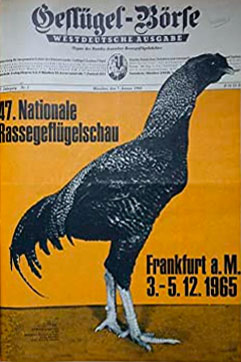
In 1966, Wilmar Vorwerk saw a picture of the Vorwerk Bantam in the German poultry paper Geflügel Börse. He was impressed by the rare color patterns and thrilled to find a breed of chicken that carried his family name. Vorwerk himself was of German descent. His father was born in the German part of West Prussia.
After a quest of multiple years to find Vorwerk eggs in the US, he decided to create his own Vorwerk Bantam variety. He started entirely from scratch and used selective breeding and genetics to carefully create the Vorwerk clones. It took him many years to do the breeding, but he eventually succeeded in his mission. His Vorwerk Bantam was admitted to the American Bantam Association standards in 1985.
Selective Breeding Procedure of Wilmar Vorwerk
For the selective breeding, he started with the following Bantams:
- Lakenvelder Bantams
- Buff Wyandotte Bantams
- Black-Tailed Buff Rosecomb Bantams
- Blue Wyandotte Bantams
- Buff Columbian Rosecomb Bantams
To kickstart his project, he set up two pens:
- A Lakenvelder cockerel with a black-tailed Rosceomb buff hen
- A buff Wyandotte cockerel on four Lakenvelder pullets
This first mating produced:
- cockerels with rose combs, white bodies, and black pigment in the neck and tail
- pullets with single combs, buff bodies, and black pigment in the neck and tail
The following season, inbreeding brothers and sisters produced a new set of varieties:
- some white-bodied birds, most of which were buff with various amounts of black pigment in the neck and tails
- half of the birds had a single comb; the other half had rose combs, independent of whether they were cockerels or pullets
With the resulting birds, he created two pens again in the next spring:
- A blue Wyandotte cockerel on single combed pullets with good buff bodies. This mating improved the slate ground color and the black velvet color of the neck and tail.
- The best single combed cockerels on the best single combed pullets. This mating gave him some well-colored chickens with buff bodies, blue necks, and tails with rose combs.
He then selected one of the cockerels in both pens to mate with the best and smallest pullets. That strategy didn’t work out as well. He had some lovely cockerels, but the hens lacked coloring, and there were a lot of rose combs.
To counter that, he got his hands on a pure Buff Columbian Rosecomb bantam cockerel with deep blacks in the hackles and tail. The following year, he mated this cockerel with his best pullets. The mating produced beautiful cockerels again, but the pullets were not yet the deep color he was hoping for. Some birds were entirely black, and about one-third carried rose combs.
From that point on, he bred his best colored single-combed birds each season to get to his end result several years later.
Summary
Vorwerk chickens are a German breed that resembles the Lakenvelder but comes with a black and gold pattern. They are decent egg layers that lay through the winter. These German birds are docile, sprightly, and excellent flyers.
There are European and US Bantam versions that were developed independently. The European Vorwerk large fowl is less common in the US and is not listed in the Standard of Perfection of the American Poultry Association.
Vorwerk chickens look astonishing, so they made our ‘10 Fancy Chickens That Go Viral On Social Media‘ list.
To learn more about chicken breeds, check out our ‘Chicken Breeds Page‘ to see every specific breed we address. Or go to our listicle breed summary on ‘The Classroom‘, or, if you’re unsure where to start, take a look at our ‘Chicken Breeds: Ultimate Beginners Guide‘.
If you’re interested in reading more on brown-colored chickens, take a look at ‘Top 15 Brown Chicken Breeds: All Beginner-Friendly‘.
Credits Featured Image: @vorwerkzwerge